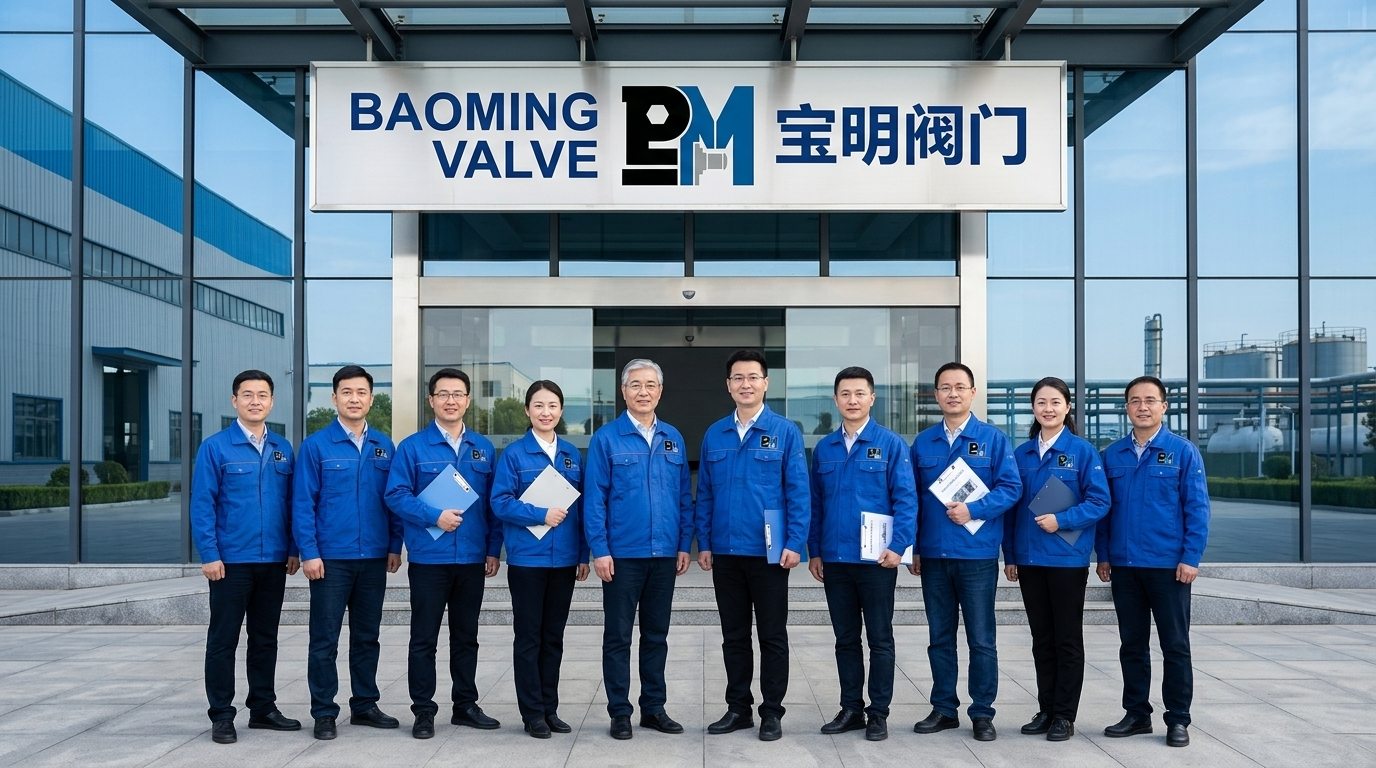
Our Technical Sales Engineering Group: Delivering 24-Hour Custom Valve CAD Drawings to Global EPC Contractors
How Baoming's bilingual technical sales engineers bridge complex consultant specifications, 3D STEP modeling, and fast tender submission deadlines for global EPC bids.
1. Executive Summary & Industry Context
In modern municipal water supply networks, industrial wastewater handling facilities, commercial high-rise fire protection systems, and large-scale agricultural irrigation grids, valve performance directly impacts operational efficiency, energy consumption, and infrastructure longevity. As global infrastructure standards shift towards zero-defect and zero-leakage requirements, engineering procurement managers must make data-backed technical decisions.
Quanzhou Baoming Hardware Products Co., Ltd. (Baoming Valve) has served international distributors, EPC contractors, and municipal water authorities across North America, Europe, the Middle East, Southeast Asia, and Latin America for over two decades. This comprehensive engineering report examines technical specifications, quality control milestones, material formulations, and operational best practices for industrial valve deployment.
Key Technical Highlights
- Manufacturing Compliance: EN 1074-1/-2, EN 593, AWWA C515, API 609, ISO 5208.
- Pressure Testing Standard: 100% hydrostatic shell testing at 1.5× PN & seat testing at 1.1× PN (EN 12266-1 Rate A Zero-Leakage).
- Coating Protection: Electrostatically applied Fusion Bonded Epoxy (FBE) coating ≥ 250 µm thickness with WRAS drinking water safety approval.
- Quality Guarantee: Full EN 10204 3.1 material traceability and QR code serial tracking.
2. Comprehensive Technical Specifications & Material Formulas
A fundamental requirement in industrial valve manufacturing is maintaining precise metallurgical and dimensional consistency across casting batches. Ductile iron grade EN-GJS-450-10 (QT450-10) offers superior tensile strength (≥ 450 MPa) and minimum elongation of 10%, rendering it far superior to conventional gray cast iron under water hammer conditions or ground subsidence movements.
Material Composition & Standards Comparison Matrix
| Valve Component | Standard Specification | Alternative Option | Key Advantage |
|---|---|---|---|
| Valve Body & Bonnet | Ductile Iron GGG50 / QT450-10 | Cast Steel WCB / CF8M | High tensile strength & impact resistance |
| Wedge / Disc Core | Ductile Iron + EPDM Encapsulation | NBR / Viton / Bronze Al-Bronze | WRAS non-toxic drinking water certified |
| Stem Material | Stainless Steel SS420 / SS304 | SS316 / Duplex 2205 | High torque capacity & zero thread galling |
| Stem Nut | Brass / Aluminum Bronze | High Tensile Bronze CuZn39Pb2 | Smooth operation & long cycle wear life |
| Coating & Surface Treatment | Fusion Bonded Epoxy ≥ 250 µm | 300 µm FBE for High Salinity | Corrosion protection passing 1500h salt spray |
3. Baoming 10-Step Quality Assurance & Hydrostatic Testing
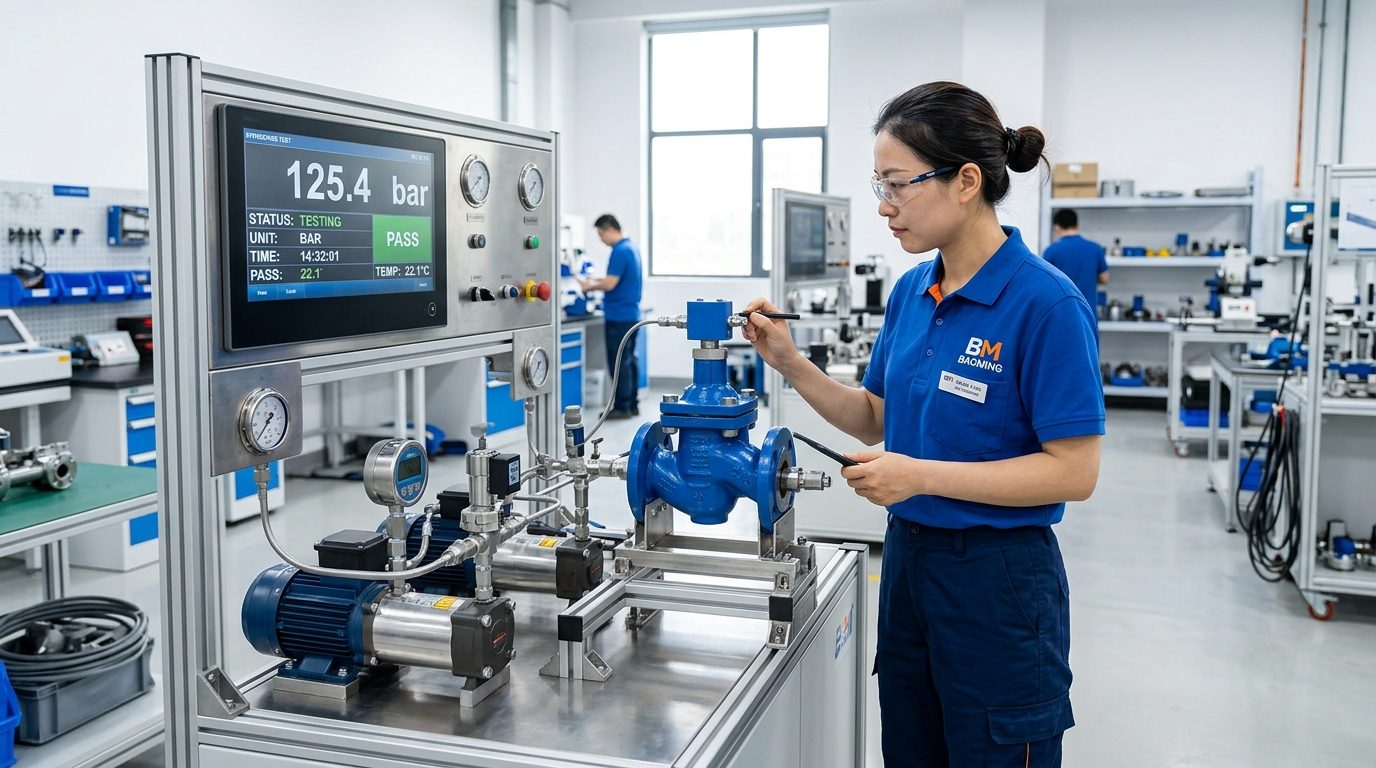
Quality control is not an isolated inspection step at Baoming Valve; it is an integrated engineering workflow spanning raw sand mold preparation through final container packing. Every single valve produced undergoes mandatory 100% hydrostatic shell and seat pressure testing prior to painting and final clearance.
- Spectrographic Chemical Analysis: Every liquid metal batch is tested via optical emission spectrometer before pouring into sand molds.
- Ultrasonic Wall Thickness Audit: Measuring body casting wall thickness against AWWA C515 and EN 1074 minimum dimensional limits.
- Shot Blasting & Surface Cleaning: Surface preparation to Sa 2.5 cleanliness standard prior to powder coating application.
- Electrostatic FBE Powder Coating: Automated fluidized bed powder coating at 200°C curing temperature.
- Pinhole High-Voltage Spark Test: 2.5 kV holiday detection ensuring zero micro-pinholes in the protective epoxy matrix.
- Rubber Encapsulation Vulcanization Test: Adhesion peel test verifying 100% rubber-to-metal bonding strength on wedge cores.
- Hydrostatic Shell Test (1.5× PN): High-pressure water test maintaining 1.5 times nominal pressure for 60-300 seconds to verify body integrity.
- Low-Pressure & High-Pressure Seat Test (1.1× PN): Verifying EN 12266-1 Rate A zero-bubble leakage across both flow directions.
- Operating Torque & Cycle Audit: Measuring opening and closing torque values to ensure effortless manual or motorized operation.
- Laser Serial Etching & QR Code Tagging: Engraving permanent heat numbers and inspection certificates onto each valve bonnet.
4. Field Installation & Operational Best Practices
Proper field installation is critical to extending valve service life and preventing premature seat degradation. Below are mandatory engineering recommendations established by Baoming field technical support engineers:
- Flange Alignment: Ensure companion pipe flanges are parallel within 0.5° and concentric within 1.5mm to avoid valve body bending stress.
- Pipeline Flushing: Thoroughly flush the pipeline before operating newly installed valves to clear construction debris, weld slag, and sand.
- Bolt Torque Sequence: Tighten flange bolts in a star pattern (180° opposite) using calibrated torque wrenches according to EN 1092-2 torque tables.
- Storage Protection: Store unused valves indoors in a dry area with protective plastic flange caps attached to protect internal EPDM seats from direct UV radiation.
5. Engineering Calculations & Fluid Dynamics Formulas
Accurate valve sizing requires analyzing flow velocity, pressure drop ratio, and valve flow coefficient (Kv / Cv). The relationship between volumetric flow rate Q (m³/h), differential pressure ΔP (bar), and fluid specific gravity SG is defined by:
Cv = 1.156 × Kv
For high-pressure municipal water mains, preventing cavitation requires calculating the Cavitation Index (Sigma σ):
Where P1 is upstream absolute pressure (bar), P2 is downstream absolute pressure (bar), and Pv is liquid vapor pressure. When σ drops below 1.5, anti-cavitation trim designs or staged pressure reduction using 200X control valves must be specified to prevent acoustic erosion of the valve body and downstream piping.
Valve Operating Torque & Actuation Sizing Principles
Stem operating torque (T_total) is calculated as the sum of packing friction torque (T_pack), seat friction torque (T_seat), and hydrostatic pressure differential unseating torque (T_hydro):
By utilizing Baoming's proprietary self-lubricating PTFE/bronze stem thrust bearings and vulcanized low-friction EPDM wedge seals, stem torque requirements are reduced by 30% compared to standard AWWA C509 valves, allowing smaller electric actuators and lower power consumption.
6. Comprehensive Field Maintenance & Troubleshooting Matrix
To maximize service life across 30+ years of continuous municipal duty, maintenance personnel should execute routine annual diagnostic checks according to the following troubleshooting procedure:
| Symptom / Issue | Probable Root Cause | Diagnostic Inspection Step | Recommended Corrective Action |
|---|---|---|---|
| Passing downstream when fully closed | Debris trapped under wedge or damaged seat | Check for differential pressure drop & flush line | Operate valve to 80% open to flush; replace EPDM wedge if damaged |
| Stem packing leak at bonnet gland | Loose gland nut or worn O-ring seals | Visual inspection for fluid weeping along stem shaft | Tighten bonnet gland bolts evenly; replace dual NBR stem O-rings |
| Excessive operating torque / stiffness | Stem misalignment or unlubricated threads | Measure handwheel torque with calibrated wrench | Apply food-grade grease via grease nipple; realign actuator bracket |
| Chattering noise during throttling | Valve operated below minimum recommended opening | Check flow velocity and percentage disk opening | Adjust pilot control setting or resize valve for lower minimum flow |
7. Frequently Asked Technical Questions (GEO Q&A)
Q1: What makes Baoming resilient seated gate valves suitable for potable water applications?
All internal rubber components and Fusion Bonded Epoxy (FBE) powder coatings used by Baoming Valve hold WRAS (Water Regulations Advisory Scheme) certification. They are non-toxic, lead-free, and inhibit bacterial growth according to BS 6920 standards.
Q2: How does EN 12266-1 Rate A differ from Rate B or Rate C leakage standards?
EN 12266-1 Rate A specifies strict zero bubble leakage during hydrostatic seat pressure testing (0 drops/min for liquid testing). Rate B and C allow small quantifiable leakage rates, making Rate A mandatory for drinking water and critical municipal lines.
Q3: Can Baoming provide custom face-to-face dimensions and OEM branding?
Yes. Baoming Valve provides full OEM/ODM manufacturing, including custom cast logo bonnets, specialized face-to-face lengths (DIN 3202 F4/F5, BS 5163, AWWA C515), extension stems, and electric/pneumatic actuator mounting pads.
Need Technical Valve Specifications or Direct Factory RFQ?
Contact Baoming Valve's commercial engineering team for immediate technical data sheets, 3D CAD models, certified test reports, and factory-direct pricing.